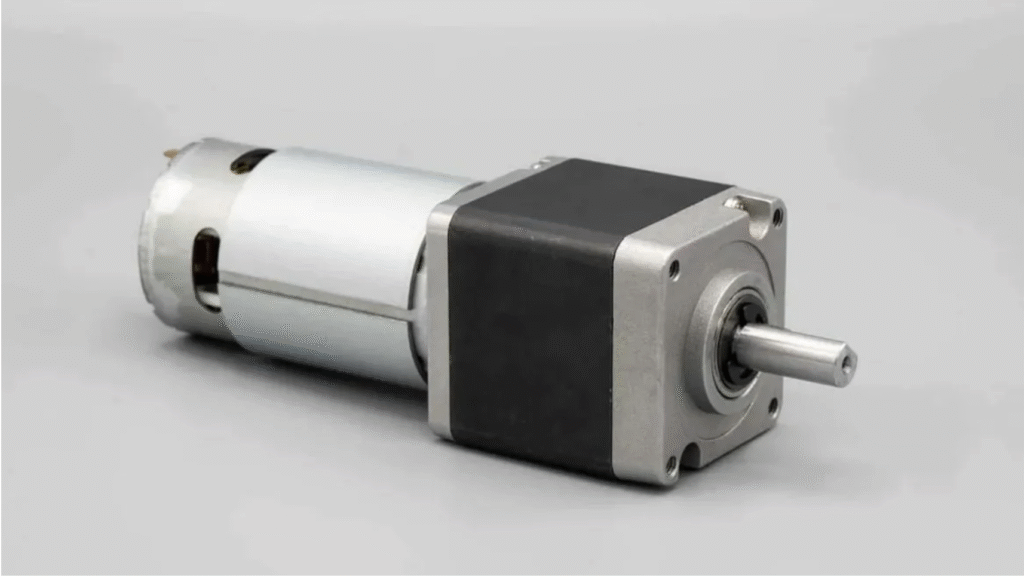
A planetary gear motor combines an electric motor with a planetary gearbox to deliver controlled speed and higher output torque in a compact design. It is commonly used in industrial automation, robotics, packaging machines, material handling equipment, machine tools, and other applications that require efficient and precise power transmission.
A planetary gear motor combines an electric motor with a planetary gear reduction system to deliver controlled speed and increased output torque in a compact design. Because the planetary gearing distributes transmitted load across multiple gears, this type of drive system can provide high torque density, efficiency and precise motion for a wide range of industrial applications.
Planetary gear motors are used in applications where space is limited but the machine still requires substantial torque, controlled speed, efficient power transmission or accurate positioning. Common applications include industrial automation, robotics, packaging machinery, material handling, machine tools and other motion-control systems.
In this guide, we explain what a planetary gear motor is, how a planetary gearbox works, its main components, types, advantages and limitations, applications, gear ratios and the factors you should consider when selecting the right planetary gear motor for an industrial application.
Quick answer: A planetary gear motor is a motor combined with a planetary gearbox. The gearbox uses a sun gear, planet gears, a planet carrier and a ring gear to reduce speed and increase output torque while maintaining a relatively compact form factor.
What Is a Planetary Gear Motor?
A planetary gear motor is a motor-and-gearbox assembly in which the motor drives a planetary gear system. The planetary gearbox reduces the motor’s rotational speed and increases the available output torque according to the selected gear ratio and gearbox design.
Unlike a simple gear arrangement in which one pair of gears carries most of the transmitted load, a planetary gearbox uses multiple planet gears around a central sun gear. This arrangement allows the transmitted load to be shared across several gear meshes.
The result is a compact transmission system that can provide a useful combination of torque density, efficiency, strength and controlled motion.
A planetary gear motor should not be confused with a planetary gearbox alone. A planetary gearbox is the mechanical reduction unit, while a planetary gear motor combines that gearbox with a motor to form an integrated drive.
For industrial applications requiring a planetary gearbox rather than a complete motor-and-gearbox assembly, see
Nextork’s Planetary Gearbox range.
How Does a Planetary Gear Motor Work?
The operating principle of a planetary gearbox is based on the interaction between four main elements: the sun gear, planet gears, planet carrier and ring gear.
- The motor provides input rotation:
The motor shaft transfers rotational motion to the planetary gearbox.
- The sun gear receives the input:
In a common arrangement, the motor drives the centrally positioned sun gear.
- The planet gears rotate and orbit:
Multiple planet gears mesh with the sun gear and the surrounding ring gear. The planet gears rotate around their own axes while also moving around the sun gear.
- The carrier transfers the output:
Depending on the gearbox configuration, the planet carrier can serve as the output member and deliver reduced-speed, higher-torque rotation.
- The gear arrangement determines the reduction:
The relationship between the sun gear, planet gears, ring gear and carrier determines the resulting speed reduction, torque multiplication and direction of rotation.
Planetary gearboxes can use different members as the input, output or fixed element. Therefore, the exact gear ratio and output behavior depend on the specific planetary gearbox configuration.
Main Components of a Planetary Gearbox
Understanding the main planetary gearbox components helps explain why the design can transmit high torque within a relatively compact housing.
1. Sun Gear
The sun gear is the centrally positioned gear in the planetary arrangement. In many configurations, it receives the input from the motor and transfers motion to the planet gears.
2. Planet Gears
Planet gears mesh with the sun gear and ring gear. Multiple planet gears can share the transmitted load, which is one of the important characteristics of planetary gearing.
3. Planet Carrier
The planet carrier supports the planet gears and can serve as the output member in common planetary gearbox arrangements.
4. Ring Gear
The ring gear is the outer gear that meshes with the planet gears. Its internal teeth form the outer part of the planetary gear arrangement.
5. Bearings and Supporting Components
Bearings and other mechanical components support the rotating members and help manage radial and axial loads. Their specification depends on the gearbox design and application.
6. Housing and Output Shaft
The gearbox housing protects the internal components and provides the required mounting structure. The output shaft transfers the resulting torque and speed to the driven machine.
Key Features of Planetary Gear Motors
- High torque density:
Multiple gear meshes can allow substantial torque transmission relative to gearbox size.
- Compact design:
The concentric arrangement of the gears can provide a compact gearbox for applications where installation space is limited.
- Load distribution:
Multiple planet gears can share the transmitted load.
- Efficient power transmission:
Planetary designs can provide efficient transmission when correctly selected and operated.
- Multiple reduction possibilities:
Planetary stages can be combined to achieve different speed-reduction ratios.
- Precision options:
Planetary gearboxes can be designed for applications where controlled motion and low backlash are important.
- Flexible integration:
A planetary gearbox can be paired with different motor types depending on the required application and drive architecture.
Advantages and Limitations of Planetary Gear Motors
Advantages
- High torque capacity relative to size
- Compact and concentric mechanical arrangement
- Load sharing across multiple planet gears
- Good efficiency when appropriately designed and operated
- Suitable for high reduction ratios using multiple stages
- Can support applications requiring controlled motion and low backlash
- Suitable for a wide range of industrial and automation applications
Limitations
- More complex construction than simple gear arrangements
- Can have a higher purchase cost than simpler gearbox designs
- Requires accurate manufacturing and assembly
- Lubrication and maintenance requirements depend on the gearbox design
- Backlash and precision characteristics vary between gearbox models
- Not every application requires the torque density or compactness of a planetary design
Types of Planetary Gear Motors
Planetary gear motors can be classified according to the motor used, gearbox configuration, reduction ratio, precision requirements and application.
1. Single-Stage Planetary Gear Motor
A single planetary stage provides a relatively moderate reduction while maintaining a compact design. It can be suitable when the required output speed and torque fall within the available ratio range.
2. Multi-Stage Planetary Gear Motor
Multiple planetary stages can be combined to achieve higher reduction ratios. As the ratio increases, output speed decreases while available output torque can increase, subject to gearbox efficiency and load limitations.
3. High-Torque Planetary Gear Motor
High-torque planetary gear motors are designed for applications where substantial output torque is required from a relatively compact transmission. Material handling, industrial machinery and heavy-duty motion systems can use this type of arrangement when the gearbox is appropriately rated.
4. Low-Backlash Planetary Gear Motor
Low-backlash planetary gearboxes are designed for applications requiring greater positioning accuracy and reduced lost motion. They can be useful in automation, robotics, machine tools and precision motion systems.
5. Planetary Gear Motor with Encoder
An encoder can provide feedback about motor position or speed. When combined with a planetary gearbox, an encoder-equipped motor can support closed-loop control systems where feedback and positioning accuracy are important.
6. DC Planetary Gear Motor
A DC motor can be paired with a planetary gearbox to create a compact geared drive. This configuration is common in compact automation and motion-control equipment, although the appropriate motor voltage and specifications depend entirely on the application.
Planetary Gear Ratio: How It Affects Speed and Torque
The gear ratio is one of the most important specifications when selecting a planetary gear motor.
In a typical reduction application:
- Lower reduction ratio: Higher output speed with a smaller increase in torque.
- Higher reduction ratio: Lower output speed with a greater increase in available output torque, subject to gearbox efficiency and rated limits.
For example, if a motor operates at a higher input speed and the machine requires a much lower output speed, a higher reduction ratio may be necessary.
However, gear ratio should not be selected based on speed alone. The gearbox must also be checked for output torque, peak load, duty cycle, service factor, allowable radial and axial loads and other application requirements.
Planetary Gear Motor vs Other Gear Motor Systems
Planetary, worm, helical and spur gear systems each have different characteristics. The appropriate choice depends on the machine rather than on a single universal “best” gearbox.
| Gear system |
Main strength |
Key consideration |
Typical applications |
| Planetary |
High torque density and compact design |
Higher mechanical complexity and potentially higher cost |
Automation, precision machinery, material handling, industrial drives |
| Worm |
Compact right-angle transmission |
Sliding friction can result in greater losses and heat |
Conveyors, machinery and applications requiring right-angle reduction |
| Helical |
Efficient power transmission and smooth operation |
May require more installation space depending on configuration |
Continuous industrial drives and material handling |
| Spur |
Simple construction and economical design |
Less suited to applications requiring very high torque density |
Simpler mechanical and motion systems |
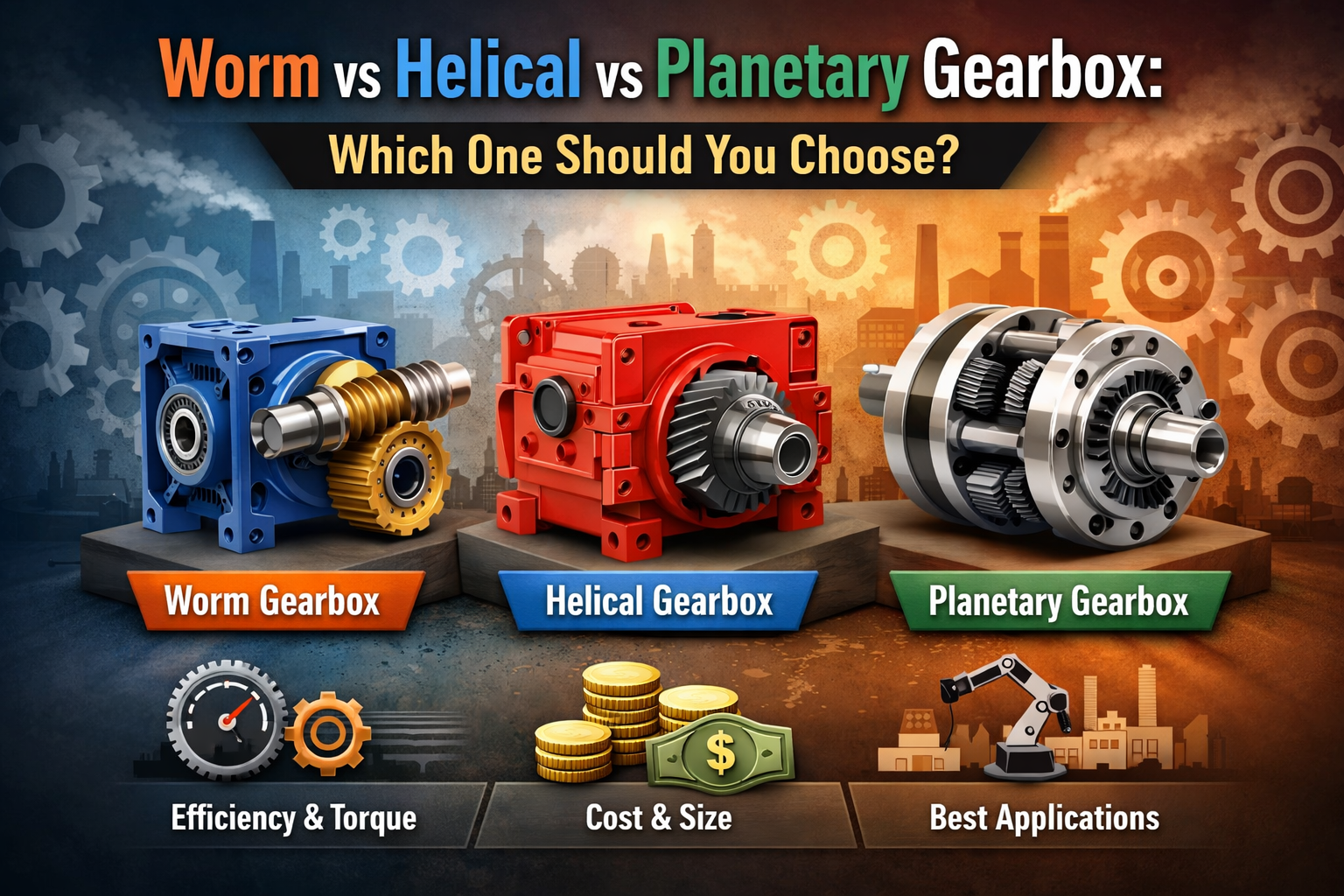
For a more detailed comparison of planetary, worm and helical gearbox designs, see
Worm vs Helical vs Planetary Gearbox
.
Planetary Gear Motor vs Planetary Gearbox
The terms planetary gear motor and planetary gearbox are closely related but do not describe exactly the same product.
| Feature |
Planetary gearbox |
Planetary gear motor |
| Main function |
Reduces speed and transmits/increases output torque |
Provides motor-driven rotation with planetary speed reduction |
| Motor included |
No |
Yes |
| Main selection factors |
Ratio, torque, speed, load, mounting and gearbox configuration |
Motor power, motor speed, ratio, output torque, duty cycle and complete drive compatibility |
| Typical use |
Mechanical transmission and machine drive systems |
Integrated motor-and-transmission applications |
If you are specifically looking for an industrial planetary gearbox, explore
Nextork’s Planetary Gearbox products.
Applications of Planetary Gear Motors
Planetary gear motors are used in applications where the machine requires a combination of compact dimensions, torque transmission, controlled speed and, in some cases, precision positioning.
Industrial Automation
Automation systems can use planetary gear motors to drive actuators, positioning systems, conveyors and other motion-control equipment where controlled output speed and torque are required.
Robotics
Robotic systems can benefit from compact geared drives where space, torque and positioning performance are important. Low-backlash configurations can be considered where positioning accuracy is a critical requirement.
Packaging Machinery
Packaging machinery frequently performs repeated motion cycles and may require accurate speed and positioning. Planetary gear motors can be used where the motor and gearbox specifications match these requirements.
Material Handling
Conveyors, lifting equipment and other material-handling systems may require substantial output torque within a controlled speed range. Planetary gearing can be considered when its torque density and mechanical configuration suit the application.
Machine Tools
Machine tools can require controlled motion and accurate positioning. A suitable planetary gearbox and motor combination may be used where low backlash, output torque and speed requirements are compatible.
Printing and Processing Equipment
Printing and processing machinery may use geared motor systems for controlled roller, feed and positioning movements.
Renewable Energy and Tracking Systems
Certain tracking and positioning systems can use geared drives where compact dimensions and controlled output motion are required.
How to Choose the Right Planetary Gear Motor
Selecting a planetary gear motor requires more than choosing the highest torque or lowest price. The motor and gearbox should be matched to the machine’s required output speed, torque, duty cycle, mounting arrangement and operating environment.
1. Determine the Required Output Torque
Calculate or obtain the torque required at the gearbox output. Consider the normal load as well as starting, acceleration and peak-load conditions.
2. Determine the Required Output Speed
Identify the required RPM at the driven machine. The required output speed will help determine the appropriate reduction ratio.
3. Select the Gear Ratio
The gear ratio should convert the motor’s available speed into the required output speed while providing sufficient output torque.
4. Check Motor Power
Confirm that the motor has sufficient power for the application, including acceleration and continuous operating requirements.
5. Check Duty Cycle
Determine whether the motor and gearbox will operate continuously, intermittently or through frequent start-stop cycles. Duty cycle can significantly affect thermal and mechanical requirements.
6. Consider Radial and Axial Loads
If the gearbox output shaft supports pulleys, sprockets, belts, chains or other external loads, verify that the gearbox can accommodate the required radial and axial loads.
7. Consider Backlash
Applications requiring precise positioning may need a low-backlash planetary gearbox. For less demanding applications, a standard backlash specification may be sufficient.
8. Check Efficiency
Gearbox efficiency affects the amount of motor power available at the output and should be considered when calculating system performance and energy requirements.
9. Check Mounting and Shaft Configuration
Confirm the available installation space, mounting dimensions, shaft diameter, shaft orientation and connection method before selecting the motor and gearbox.
10. Consider the Operating Environment
Temperature, dust, moisture, vibration and other environmental conditions can influence gearbox and motor selection.
11. Check Service Factor
The gearbox should be selected with an appropriate service factor based on the load type, operating hours, starting frequency and other application conditions.
12. Confirm Motor and Gearbox Compatibility
If the motor and gearbox are supplied separately, confirm that the motor flange, shaft, mounting arrangement and torque requirements are compatible with the gearbox.
Planetary Gear Motor Selection Checklist
| Parameter |
What to determine |
Why it matters |
| Output torque |
Continuous and peak torque |
Determines whether the gearbox can handle the load |
| Output speed |
Required RPM |
Determines the required reduction ratio |
| Gear ratio |
Required speed reduction |
Affects output speed and available torque |
| Motor power |
Required kW/HP |
Determines available input power |
| Duty cycle |
Continuous or intermittent operation |
Influences thermal and mechanical loading |
| Backlash |
Permissible lost motion |
Important for positioning and precision applications |
| External loads |
Radial and axial loads |
Ensures shaft and bearing capacity is appropriate |
| Environment |
Temperature, dust, moisture and vibration |
Affects motor and gearbox selection |
Planetary Gear Motor Maintenance
Proper maintenance helps maintain gearbox performance and service life. The exact maintenance interval depends on the gearbox design, lubricant, operating conditions and manufacturer’s recommendations.
- Check lubrication: Confirm the correct lubricant type, level and replacement interval according to the manufacturer’s instructions.
- Inspect for leakage: Check seals and housing areas for signs of lubricant leakage.
- Monitor temperature: Unusual temperature increases can indicate excessive loading, lubrication problems or mechanical issues.
- Listen for abnormal noise: Changes in operating noise or vibration can indicate gear, bearing or alignment problems.
- Check mounting: Verify that mounting bolts and mechanical connections remain secure.
- Inspect the output shaft: Check for abnormal wear, looseness or damage where applicable.
Always follow the maintenance instructions supplied with the specific planetary gearbox or gear motor.
How to Choose a Planetary Gear Motor Supplier
Choosing a supplier should involve more than comparing the initial price of a gearbox or gear motor. The supplier should be able to understand the application and provide a suitable combination of motor, gearbox, ratio, mounting and output requirements.
When evaluating a planetary gearbox or planetary gear motor supplier, consider:
- Available gearbox ratios and torque ranges
- Motor compatibility
- Mounting and shaft configurations
- Technical documentation and dimensional drawings
- Application engineering support
- Availability of replacement parts and service
- Required delivery timelines
- Experience with the intended industrial application
Nextork provides industrial transmission solutions including planetary gearbox products from established transmission brands. You can explore the available
Planetary Gearbox range
to review the product options.
Planetary Gearbox Solutions from Nextork
Nextork provides industrial transmission products for applications across automation, material handling, packaging, machinery and other industrial sectors. Its current planetary product category includes multiple planetary gearbox configurations, including products from Wanshsin and DANA/BREVINI as well as several W-series planetary gearbox designs.
If you are selecting a planetary gearbox for an industrial application, the required motor power, output speed, output torque, gear ratio, mounting arrangement, duty cycle and environmental conditions should be considered before choosing a product.
Explore
Nextork’s Planetary Gearbox range
or
contact the Nextork team
with your application requirements.
Frequently Asked Questions About Planetary Gear Motors
What is a planetary gear motor?
A planetary gear motor is a motor combined with a planetary gearbox. The gearbox uses a sun gear, planet gears, a carrier and a ring gear to reduce speed and increase output torque in a compact transmission arrangement.
How does a planetary gear motor work?
The motor provides input rotation to the planetary gearbox. The sun gear transfers motion to multiple planet gears, which interact with the ring gear and carrier. The resulting gear arrangement reduces speed and increases available output torque according to the selected configuration and ratio.
What are the main parts of a planetary gearbox?
The main components include the sun gear, planet gears, planet carrier and ring gear. A complete gearbox also includes supporting components such as bearings, housing, seals and an output shaft.
What are the advantages of a planetary gear motor?
Key advantages include high torque density, compact construction, load sharing across multiple gears, efficient power transmission and the ability to achieve different reduction ratios through planetary stages.
Where are planetary gear motors used?
Planetary gear motors can be used in industrial automation, robotics, packaging machinery, material handling, machine tools, printing equipment and other applications requiring controlled speed and torque in a compact drive system.
What is the difference between a planetary gear motor and a planetary gearbox?
A planetary gearbox is the mechanical reduction unit. A planetary gear motor combines a motor with that gearbox to provide an integrated drive system.
How does gear ratio affect a planetary gear motor?
A higher reduction ratio generally produces lower output speed and higher available output torque, subject to gearbox efficiency and rated limits. The required ratio should be selected according to the machine’s required output speed and torque.
What is a low-backlash planetary gearbox?
A low-backlash planetary gearbox is designed to minimize lost rotational movement between the input and output. It is commonly considered for precision applications where positioning accuracy is important.
Are planetary gear motors suitable for high-torque applications?
Planetary gear systems can provide high torque density because multiple planet gears share the transmitted load. However, the gearbox must still be selected according to its rated continuous and peak torque, duty cycle and application requirements.
What is the difference between planetary, worm and helical gearboxes?
Planetary gearboxes are known for compact construction and high torque density. Worm gearboxes can provide compact right-angle transmission, while helical gearboxes are commonly used for efficient continuous power transmission. The appropriate choice depends on the machine’s speed, torque, space, efficiency and mechanical requirements.
What factors affect planetary gearbox life?
Gearbox life can be affected by load, speed, duty cycle, lubrication, operating temperature, alignment, external radial or axial loads and maintenance. Selecting the gearbox with an appropriate service factor is important for long-term operation.
Conclusion
A planetary gear motor combines a motor with a planetary reduction system to provide controlled output speed and increased torque within a compact mechanical arrangement. Its sun gear, planet gears, carrier and ring gear work together to distribute transmitted load and achieve the required speed reduction.
Planetary gear motors can be particularly useful in automation, robotics, packaging, material handling, machine tools and other industrial applications where torque density, compactness, efficiency or controlled motion are important.
The correct selection should be based on output torque, output speed, gear ratio, motor power, duty cycle, backlash, external loads, mounting configuration, operating environment and service factor rather than price or motor power alone.
Looking for a Planetary Gearbox?
Need help identifying the right planetary gearbox for your industrial application? Share your required output speed, torque, motor power, gear ratio and mounting requirements with the Nextork team.
Explore Planetary Gearboxes
Contact Nextork