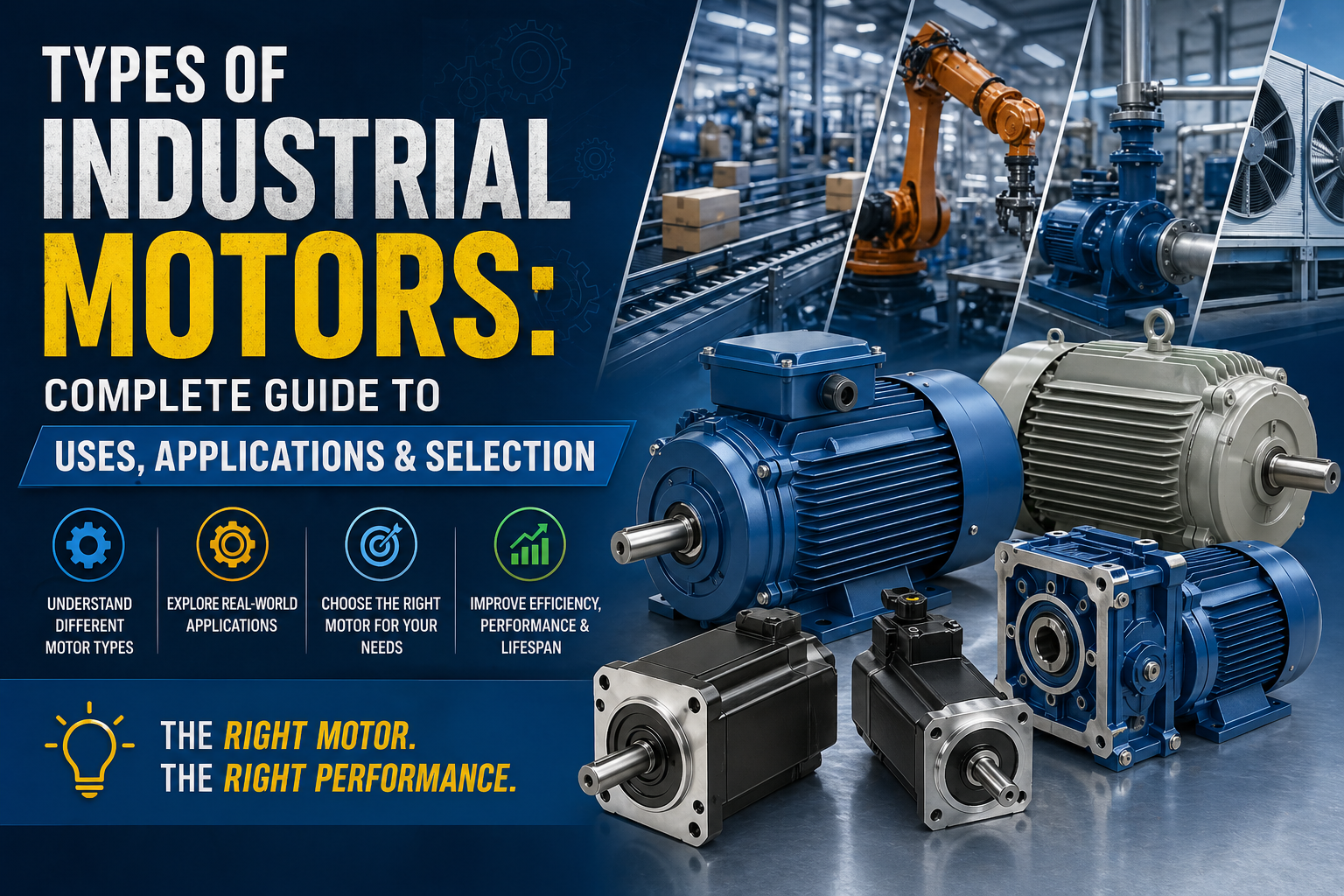
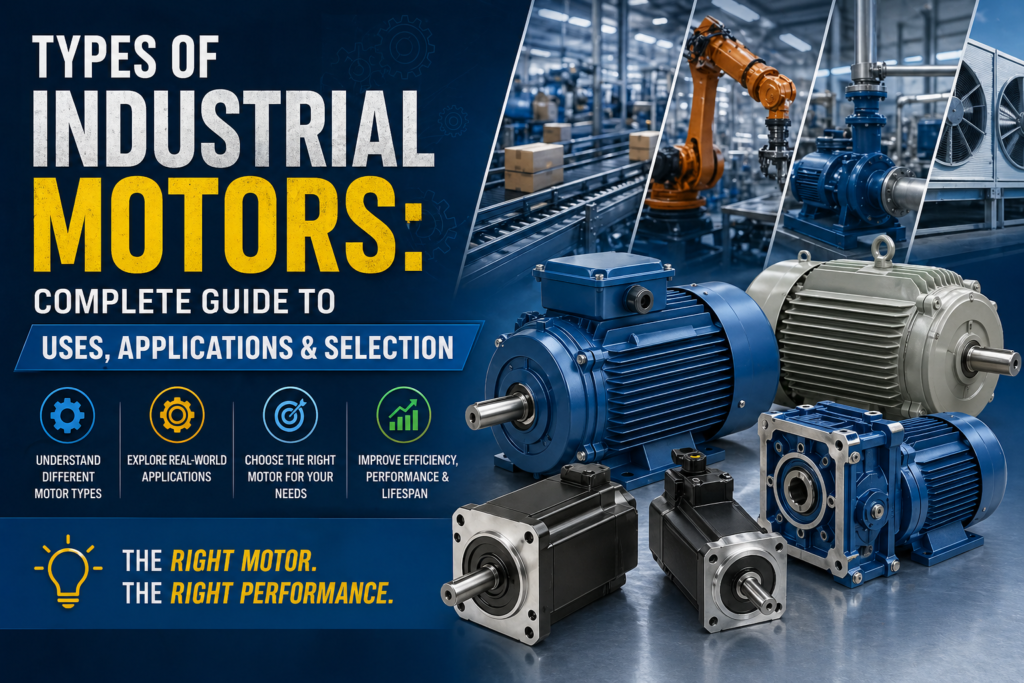
Industrial motors are the backbone of modern machinery. From conveyor belts and manufacturing lines to robotics and HVAC systems, almost every industrial process depends on motors to function efficiently.
Different machines require different performance levels – some need high torque, some need precision, and others require continuous operation. That’s why understanding the types of industrial motors is critical for selecting the right system.
There are multiple electric motor types in industry, each designed for specific use cases and operating conditions. Choosing the wrong motor can lead to inefficiency, higher energy consumption, and equipment failure.
In this guide, we’ll break down the main industrial motor applications, explain different motor types, and help you understand which motor fits your requirement.
What Are Industrial Motors?
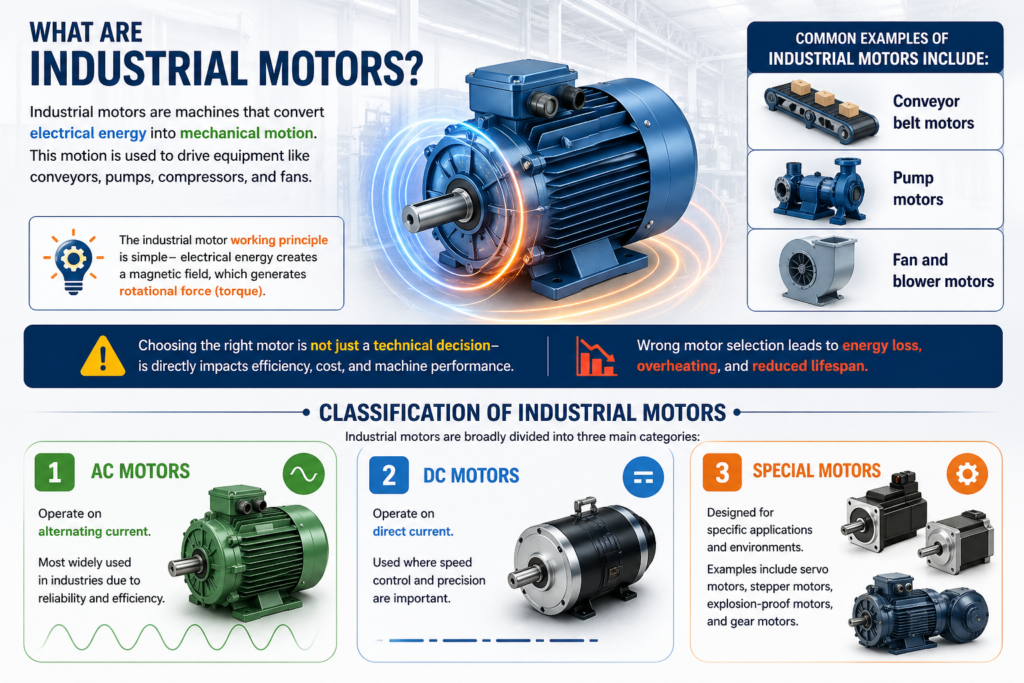
Industrial motors are machines that convert electrical energy into mechanical motion. This motion is used to drive equipment like conveyors, pumps, compressors, and fans.
The industrial motor working principle is simple- electrical energy creates a magnetic field, which generates rotational force (torque).
Common examples of common industrial motors include:
- Conveyor belt motors
- Pump motors
- Fan and blower motors
Choosing the right motor is not just a technical decision- it directly impacts efficiency, cost, and machine performance. Wrong motor selection leads to energy loss, overheating, and reduced lifespan.
Classification of Industrial Motors
Industrial motors are broadly divided into three main categories:
1. AC Motors
Operate on alternating current. Most widely used in industries due to reliability and efficiency.
2. DC Motors
Operate on direct current. Used where speed control and precision are important.
3. Special Motors
Include servo motors, stepper motors, and gear motors used in automation and specialized applications.
This classification helps in understanding the different types of electric motors and building a clear industrial motors list based on application.
Types of Industrial Motors
1. AC Motors (Most Widely Used)
AC motors are the most commonly used types of motors used in manufacturing due to their durability and low maintenance.
Types of AC Motors
1. Induction Motor
- Most widely used motor in industry
- Simple design and reliable operation
- Used in pumps, fans, compressors
2. Synchronous Motor
- Runs at constant speed
- Used where precise speed is required
AC motors are available as three phase motor vs single phase motor:
- Three-phase → used in heavy industrial applications
- Single-phase → used in smaller systems
These motors fall under AC motors (induction motor, synchronous motor) and dominate most industrial setups.
2. DC Motors
DC motors are used where speed control and accuracy are important.
Types of DC Motors
1. Brushed DC Motor
- Simple and cost-effective
- Requires maintenance due to brushes
2. Brushless DC Motor
- High efficiency
- Longer lifespan
- Low maintenance
These motors are widely used in robotics and precision machines, making them important in AC vs DC motor industrial applications.
3. Servo Motors
Servo motors are designed for high precision and controlled movement.
They are used in systems where position, speed, and torque need to be accurately controlled.
Key Uses
- CNC machines
- Robotics
- Automation systems
Servo motors are critical automation motors in manufacturing, especially where accuracy matters.
4. Stepper Motors
Stepper motors move in fixed steps instead of continuous rotation.
This allows precise control over position without feedback systems.
Applications
- 3D printers
- CNC machines
- Position control systems
These are common stepper motor uses in industry, especially in low-speed precision applications.
5. Gear Motors
Gear motors combine a motor with a gearbox to deliver higher torque at lower speeds.
They are widely used in applications where force is more important than speed.
Why They Are Used
- High torque output
- Speed reduction
- Better control
Applications
- Conveyor systems
- Heavy machinery
- Industrial automation
Gear motors are essential in gear motors in manufacturing and represent practical industrial motor types and uses.
Applications of Industrial Motors
Industrial motors are used across multiple industries depending on requirements.
1. Manufacturing
- Assembly lines
- Machine tools
- Production equipment
2. Material Handling
- Conveyor belt systems
- Lifting equipment
3. Robotics & Automation
- Precision movement systems
- CNC machines
4. HVAC Systems
- Fans
- Compressors
- Blowers
These examples highlight real industrial motor applications and types of motors used in manufacturing.
AC vs DC Motors – Key Difference
| Feature | AC Motors | DC Motors |
| Power Source | Alternating current | Direct current |
| Efficiency | High | Moderate to high |
| Maintenance | Low | Higher (especially brushed) |
| Cost | Lower | Higher |
| Control | Limited | Excellent speed control |
| Applications | Heavy industry | Precision systems |
This comparison helps understand AC vs DC motor industrial applications and where each fits in real-world use.
Factors to Consider When Choosing an Industrial Motor
Selecting the right motor depends on multiple factors.
1. Load Requirement
Heavy loads require motors with higher power and durability.
2. Speed Requirement
Different machines require different speeds — high-speed vs controlled motion.
3. Torque
Understanding torque vs speed in motors is critical.
High torque → heavy machines
High speed → lighter operations
4. Environment
Dust, heat, and moisture affect motor selection.
5. Efficiency
Motor efficiency directly impacts motor efficiency and power consumption.
Practical Example
- Conveyor system → gear motor or induction motor
- Robotic arm → servo motor
This is where real motor selection criteria comes into play.
Energy Efficiency in Industrial Motors
Energy efficiency is a major factor in modern industries due to rising energy costs.
Motors are classified into efficiency levels:
- IE2 → Standard efficiency
- IE3 → Premium efficiency
- IE4 → Super premium efficiency
These IE3 IE4 motors efficiency classes help industries reduce power consumption and improve performance.
Using energy efficient motors in industry leads to:
- Lower electricity bills
- Reduced heat loss
- Better machine lifespan
Conclusion
There are multiple types of industrial motors, and each is designed for a specific purpose.
- AC motors → reliable and widely used
- DC motors → precise and controllable
- Servo & stepper → automation and accuracy
- Gear motors → high torque applications
There is no one-size-fits-all solution. The right choice depends on application, load, speed, and efficiency requirements.
Understanding industrial motor types and uses helps improve performance, reduce costs, and increase machine reliability.
Need Help Choosing the Right Industrial Motor?
Selecting the right motor for your machine is not just about power; it’s about matching performance with application.
At Nextork, we help industries choose the right motor solutions based on real requirements whether it’s for automation, heavy machinery, or production systems.
If you’re planning a new setup or upgrading an existing system, choosing the right motor can significantly improve efficiency and reduce long-term costs.
Frequently Asked Questions (FAQs)
1. What are the main types of industrial motors?
The main types of industrial motors are AC motors, DC motors, servo motors, stepper motors, and gear motors.
AC motors are widely used for general applications, DC motors are used for speed control, while servo and stepper motors are ideal for precision and automation systems.
2. Which type of motor is most commonly used in industries?
Induction motors (a type of AC motor) are the most commonly used in industries due to their simple design, low cost, durability, and minimal maintenance requirements.
3. What is the difference between AC and DC motors?
- AC motors run on alternating current and are best for continuous, heavy-duty operations.
- DC motors run on direct current and provide better speed control and precision, making them suitable for robotics and automation.
4. What are servo motors used for in industry?
Servo motors are used in applications requiring high precision and controlled movement, such as:
- CNC machines
- Robotics
- Automated manufacturing systems
They allow accurate control of position, speed, and torque.
5. What are industrial motor applications?
Industrial motors are used in:
- Robotics and automation systems
- Manufacturing (assembly lines, machine tools)
- Material handling (conveyors, lifting equipment)
- HVAC systems (fans, compressors, blowers)
6. What is a gear motor and where is it used?
A gear motor is a combination of a motor and a gearbox designed to reduce speed and increase torque.
It is commonly used in:
- Conveyor systems
- Heavy machinery
- Industrial automation
7. How do I choose the right industrial motor?
Choosing the right motor depends on:
- Load requirement (light vs heavy)
- Speed and torque needs
- Operating environment (dust, heat, moisture)
- Energy efficiency requirements
For example, gear motors are ideal for conveyors, while servo motors are best for robotic arms.
8. What happens if you choose the wrong motor?
Selecting the wrong motor can lead to:
- Energy loss
- Overheating
- Increased maintenance costs
- Reduced equipment lifespan