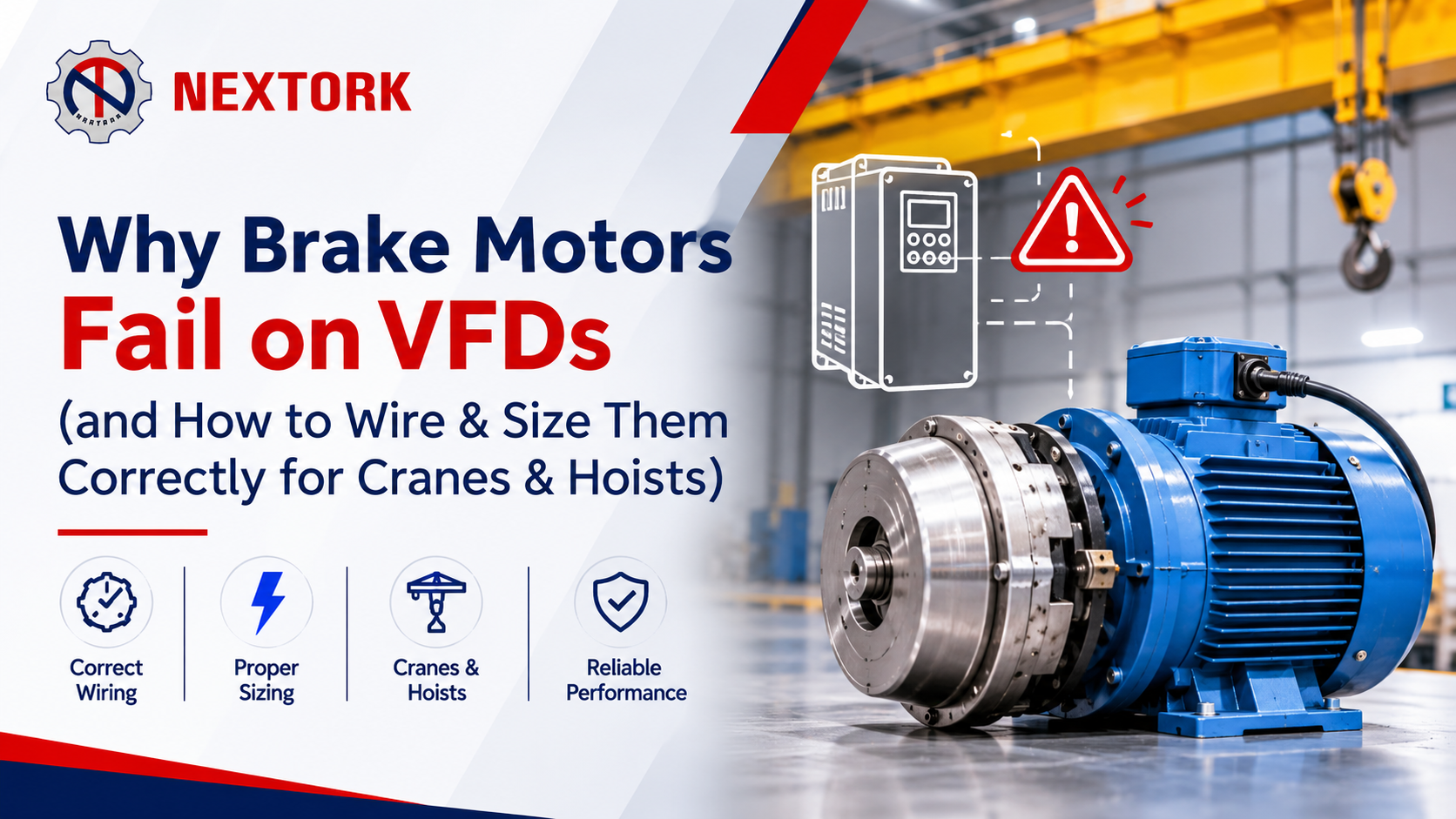
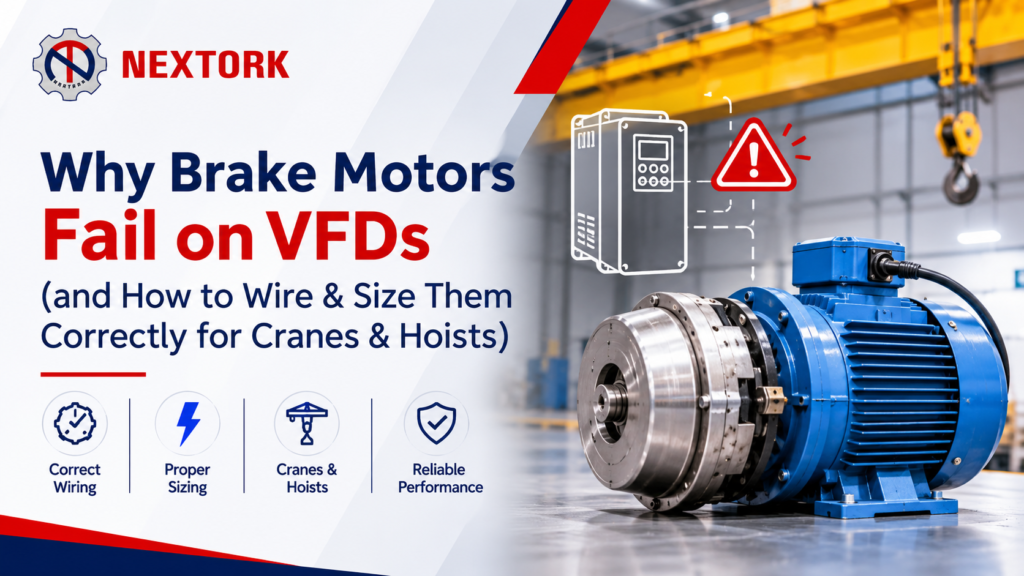
Why Brake Motors Fail on VFDs (and How to Wire & Size Them Correctly for Cranes & Hoists)
A brake motor that runs cleanly on a direct-on-line supply can start overheating, tripping or dragging the moment it is connected to a variable frequency drive. The motor hums, current rises, and the electric motor brake never fully releases — or only partly opens. This is a common field issue on cranes, hoists and other intermittent-duty machines.
The cause is usually not a “bad VFD” or a defective motor. In most cases the motor brake is still being fed from the motor terminals. On a VFD those terminals no longer stay at full voltage during ramp-up, so the brake does not get the release voltage it needs.
This guide explains why a brake motor on a VFD fails, how to wire the brake correctly, how to size it for crane and hoist duty, and when a standard motor is not enough.
Why a Brake Motor Fails on a VFD
On a direct-on-line starter, the motor terminals are energised at full line voltage as soon as the contactor closes. If the brake coil is wired across those same terminals, it receives full voltage and releases.
On a VFD the situation changes:
- The drive outputs a variable voltage and frequency as it ramps the motor from standstill.
- At low frequency the voltage at the motor terminals is reduced.
- If the brake coil is still taken from those terminals, it does not receive enough voltage to release fully.
The brake stays clamped or only partly opens. The motor then tries to turn against a closed or dragging brake. Current climbs, the drive may trip on overload, the motor overheats, and the brake lining wears faster than designed.
Even a partial release is damaging: the motor turns against residual friction, heat builds in both the brake and the windings, and the problem often appears only after repeated start–stop cycles.
What Goes Wrong on Cranes and Hoists
Cranes and hoists make the failure more visible because the duty is intermittent, starting torque is high, and the load must be held safely.
Load drop at start or stop
If the mechanical brake opens before the drive has developed holding torque — or closes while the shaft is still moving — the load can drop a short distance. On a hoist this shows up as a measurable load drop and increased mechanical stress on the drivetrain.
Overheating and nuisance trips
Repeated cycles with a partially released brake push both the motor and the brake beyond their thermal capacity. Overload trips and high winding temperature become frequent, especially on high-cycle duty.
Wrong motor for the duty
A general-purpose continuous-duty motor (typically S1) is not designed for the frequent starting, stopping and reversing found on cranes and hoists. Those applications usually need a crane duty motor rated for intermittent duty (commonly S3, S4 or S5 under IEC 60034-1) and, where required, an integrated or matched brake motor arrangement.
Brake torque and holding
Holding a suspended load is not the same as stopping a free-running conveyor. Brake torque, thermal capacity and the control sequence must match the real operating cycle. Undersizing shows up as load drop, overheating or unreliable holding under peak conditions.
How to Wire a Brake Motor Correctly on a VFD
The fix starts with how the brake is powered and when it is allowed to release.
1. Power the brake from a separate supply
Do not feed the brake coil from the variable motor leads when the motor is on a VFD. Provide a constant supply so the brake receives full release voltage whenever the control system commands it to open.
Options include:
- A dedicated brake supply from the control panel
- A VFD brake-control output (where the drive supports it)
- A separately terminated brake coil on an inverter-duty brake motor
2. Confirm coil type and voltage
Brake coils may be AC or DC. Many industrial brakes use a DC coil fed through a rectifier. Check the nameplate and the manufacturer’s data for:
- Coil voltage
- Whether a rectifier is required
- Release and application times
3. Coordinate release and engage timing with the drive
Typical safe sequence:
- Drive builds torque at low frequency
- Brake is released only when the drive can hold the load
- On stop, the drive decelerates the load
- Brake is applied after the shaft speed is near zero
Many crane and hoist VFDs expose parameters for brake release frequency, brake engage frequency and hold time. These must be set for the actual motor, brake and load — not left at generic defaults.
4. Specify an inverter-duty arrangement when ordering
When the motor will run on a VFD, specify a brake motor with separate brake terminals (or a clearly documented separate brake supply). Avoid designs where the brake is permanently wired only to the motor terminals with no alternative supply path.
For a broader overview of brake motor types and selection points, see Nextork’s guide to industrial brake motors and electric motor brakes.
How to Size a Brake Motor for Crane and Hoist Duty
Wiring fixes the release problem. Sizing fixes the thermal and holding problem.
Brake torque
Brake torque must be sufficient for the stopping and holding duty of the application. For lifting applications, manufacturers and standards often require the brake to hold more than the motor’s rated torque. Exact factors depend on the crane or hoist design and the applicable safety rules — always confirm against the project specification and manufacturer data.
Duty cycle
IEC 60034-1 defines standard duty types. For cranes and hoists the relevant intermittent duties commonly include:
| Duty type | Description | Typical relevance |
|---|---|---|
| S3 | Intermittent periodic duty | Light crane drives, lower cycle rates |
| S4 | Intermittent periodic duty with starting | Hoist drives, frequent start–stop |
| S5 | Intermittent periodic duty with electric braking | Applications with frequent starting and electric braking |
A continuous-duty (S1) motor is generally not the right starting point for high-cycle lifting. Use a motor whose thermal rating matches the real operating pattern.
When a standard motor is not enough
Choose a dedicated crane duty motor or a properly rated brake motor when:
- The application involves frequent starting, stopping or reversing under load
- High starting torque is required to move a suspended or high-inertia load
- A holding brake is required for safety or positioning
- The motor will operate on a VFD with coordinated brake control
Nextork’s overview of crane duty motors — types, duty cycles and selection covers how brake motors, slip-ring and squirrel-cage options fit different crane motions.
Checklist Before You Order or Retrofit
Use this list before specifying a replacement or a new drive package:
- Will the motor run on a VFD? If yes, the brake needs a separate, constant supply path.
- Application: Crane hoist, trolley, long travel, conveyor, or other?
- Brake torque and holding requirement: Confirm against load and safety requirements.
- Duty cycle: S3, S4, S5 or equivalent — match starts/stops per hour and running time.
- Motor data: Power, speed, voltage, mounting, frame and IP rating.
- Brake coil: Voltage, AC or DC, rectifier requirement, release/application times.
- Replacement: If swapping an existing motor, photograph the nameplate and mounting arrangement.
When to Choose a Brake Motor or Crane Duty Motor from Nextork
Nextork supplies industrial brake motors and crane duty motors for material-handling and intermittent-duty applications, including configurations from brands such as LHP and Rotomotive.
When you enquire, share:
- Required power and speed
- Supply voltage
- Mounting arrangement
- Duty cycle and application (crane, hoist, conveyor, etc.)
- Whether the motor will run on a VFD
- Any existing nameplate or brake coil details
That information is enough to identify a suitable brake motor or crane duty configuration and to confirm whether a separate brake supply arrangement is required.
Need a brake motor or crane duty motor for a VFD-driven crane or hoist?
Request a technical quote or speak with the Nextork team about your application.
Frequently Asked Questions
Why does a brake motor fail on a VFD?
Most often because the brake coil is still powered from the motor terminals. On a VFD those terminals do not stay at full voltage during ramp-up, so the brake does not release fully. The motor then runs against a closed or dragging brake, causing overheating, trips and accelerated wear.
How should a brake motor be wired on a VFD?
Power the brake from a separate, constant supply — or from a drive brake-control output — not from the variable motor leads. Confirm coil voltage and rectifier requirements, and coordinate brake release with the drive so the brake opens only when the drive can hold the load.
What is the difference between a brake motor and a crane duty motor?
A brake motor is a motor with an integrated or matched braking system for stopping and holding. A crane duty motor is designed for intermittent duty, high starting torque and the thermal stresses of crane and hoist service. Many crane applications use a crane duty motor that is also a brake motor.
How do I size brake torque for a hoist or crane?
Brake torque must cover the stopping and holding duty of the real load. Lifting applications often require the brake to hold more than the motor’s rated torque. Always confirm the required factor against the crane or hoist specification and the motor/brake manufacturer’s data.
Can I put a standard motor with a separate brake on a crane?
Only if the motor’s duty rating, starting torque and thermal capacity match the application, and the brake is correctly sized and controlled. In practice, frequent start–stop lifting is better served by a motor rated for crane duty and a brake arrangement designed for that service.
Conclusion
When a brake motor on a VFD overheats or fails to release, the usual cause is brake supply and duty mismatch — not a fundamental incompatibility between brake motors and drives. Feed the brake from a constant supply, coordinate release with the drive, and select a motor and brake rated for the real intermittent duty.
For cranes and hoists that means paying attention to duty cycle, holding torque and control sequence — and choosing a suitable brake motor or crane duty motor rather than forcing a continuous-duty machine into intermittent lifting service.
If you are specifying a new drive package or replacing a motor that has been overheating or dropping load, share your power, duty and application details with the Nextork team for a configuration that matches the way the machine actually runs.
Technical references for duty types and motor classification are based on IEC 60034-1 and related industrial practice. Always confirm safety-critical holding and braking requirements with the applicable crane/hoist standards and the equipment manufacturer.