Introduction
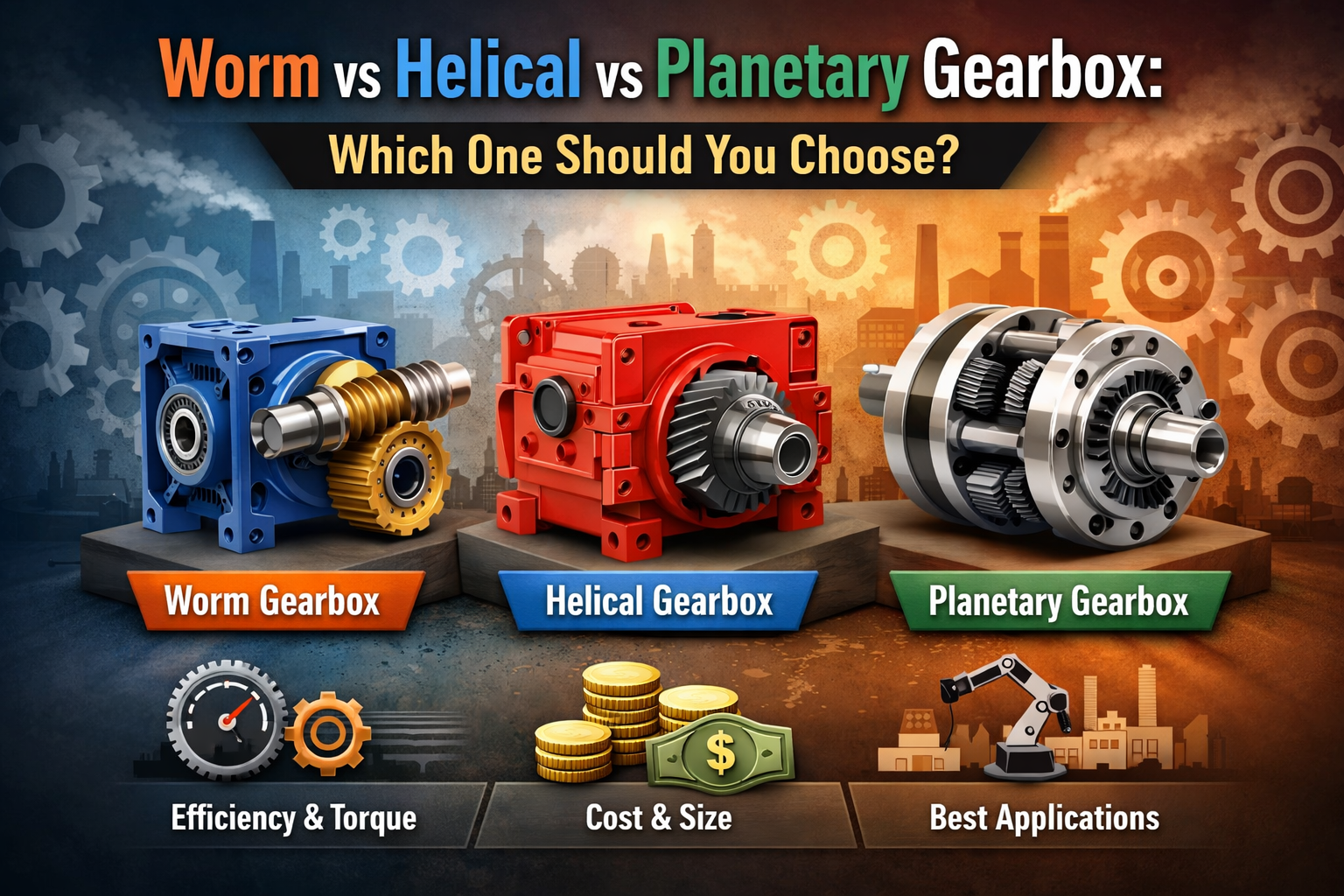
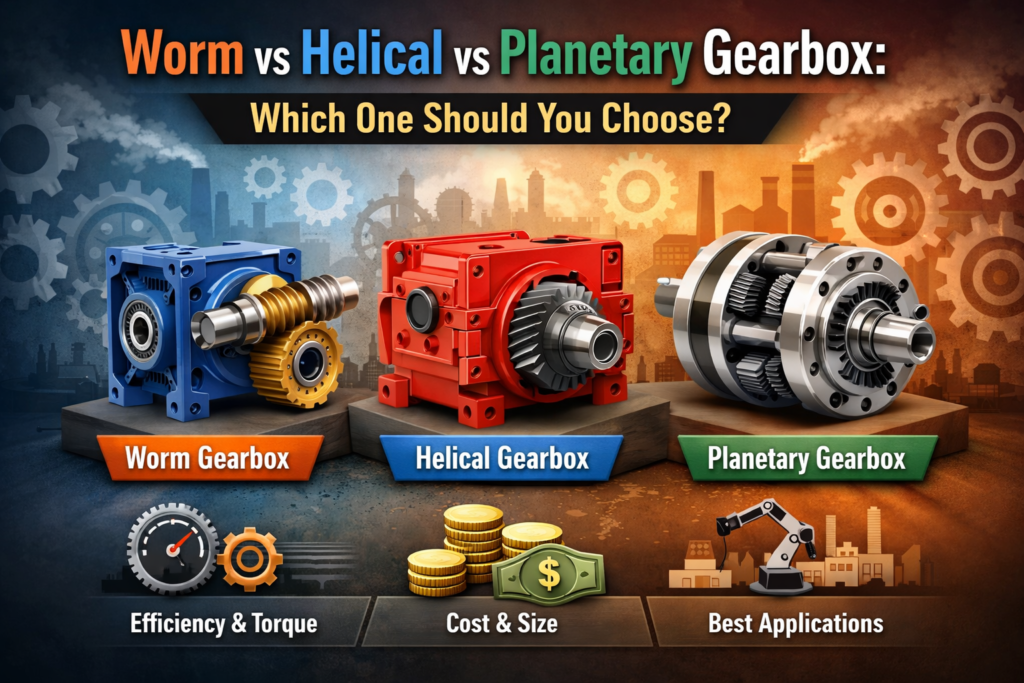
When selecting a gearbox for an industrial machine, many buyers get confused between different types available in the market. The most common comparison happens between worm vs helical vs planetary gearbox, because these three are widely used across industries like material handling, packaging, heavy machinery, and automation.
Each gearbox type has a different design, different efficiency level, and different load handling capacity. Choosing the wrong one can lead to power loss, overheating, or even machine failure.
In this guide, we will clearly explain the gearbox types and differences, compare their performance, and help you understand how to choose gearbox based on your application, load, speed, and space requirements.
What is a Gearbox?
A gearbox is a mechanical device used to control speed and increase torque in a machine. It is also called a reduction gearbox or speed reducer, because it reduces motor speed and increases output force. In industrial machines, motors rotate at high speed but low torque. Most machines require lower speed and higher power. This is where a gearbox helps in torque transmission.
Gearboxes are commonly used with an industrial gear motor in conveyors, mixers, cranes, packaging machines, and heavy-duty equipment.
Main functions of a gearbox:
- Reduce speed
- Increase torque
- Change direction of rotation
- Improve machine efficiency
Types of Gearboxes Used in Industry
There are many gearbox designs available, but the most commonly used in industrial applications are:
- Worm gearbox
- Helical gearbox
- Planetary gearbox
These are considered the most reliable gearbox types and differences come mainly from efficiency, load capacity, size & torque output, cost & application type. Among these, planetary and helical are usually considered high efficiency gearbox types, while worm gearboxes are used when compact design or right-angle output is needed.
What is a Worm Gearbox?
A worm gearbox uses a screw-shaped gear called a worm, which rotates a worm wheel. This design creates a right angle gearbox, where input and output shafts are at 90 degrees because of its structure, the worm gearbox is known for its compact gearbox design and smooth operation.
Key features
- Right angle output design
- Compact gearbox design
- Smooth and quiet operation
- Suitable for moderate load applications
- Can provide high gear reduction in small size
Advantages
- Space-saving design
- Low cost compared to other gearboxes
- Suitable for conveyors and lifting systems
- Good for applications where speed reduction is high
Limitations
- Lower efficiency compared to helical and planetary
- Heat generation at high load
- Power loss due to sliding friction
- Not ideal for very heavy-duty use
The efficiency of worm gearbox is usually lower, which makes it less suitable for high-power applications.
What is a Helical Gearbox?
A helical gearbox uses angled teeth instead of straight teeth. This allows smoother contact between gears and better power transmission. Helical gearboxes are often used as an inline gearbox, where input and output shafts are in the same line.
Key Features
- Inline gearbox design
- High load capacity
- Smooth and quiet operation
- High efficiency power transmission
- Suitable for continuous operation
Advantages
- Higher efficiency than worm gearbox
- Strong torque transmission
- Long service life
- Suitable for heavy-duty machines
- Low vibration and noise
Limitations
- Bigger size compared to worm gearbox
- Higher cost than worm gearbox
- Requires proper alignment during installation
Planetary gearboxes are ideal for applications where high torque gearbox performance is needed with a compact gearbox design. They are widely used in robotics, automation, CNC machines, and heavy-duty industrial equipment.
Key Differences Explained
The difference between worm and helical gearbox is mainly efficiency and load handling. Worm is compact but less efficient, while helical is stronger and more efficient. In worm gearbox vs planetary gearbox, planetary gives higher torque and better performance but costs more.
In helical gearbox vs planetary gearbox, planetary is smaller and more precise, while helical is better for continuous heavy-duty use.
How to Choose the Right Gearbox for Your Application
Selecting the correct gearbox depends on several factors. If you understand the application, you can easily decide how to choose gearbox correctly.
When selecting, always check:
- Load requirement
- Speed requirement
- Space available
- Efficiency needed
- Cost limit
This helps in deciding how to select gearbox for application and which gearbox is best for industrial use.
Based on Load & Torque
If the machine needs high power, then load capacity becomes important.
For heavy applications:
- Planetary → best gearbox for heavy load
- Helical → good for continuous load
- Worm → suitable for light to medium load
Based on Speed & Efficiency
If the machine needs high power, then load capacity becomes important.
For heavy applications:
- Planetary → best gearbox for heavy load
- Helical → good for continuous load
- Worm → suitable for light to medium load
Based on Space & Design
Sometimes space decides the gearbox.
- Right angle gearbox → worm
- Inline gearbox → helical
- Compact gearbox design → planetary
If machine size is limited, compact gearboxes are preferred.
Applications of Worm, Helical & Planetary Gearboxes
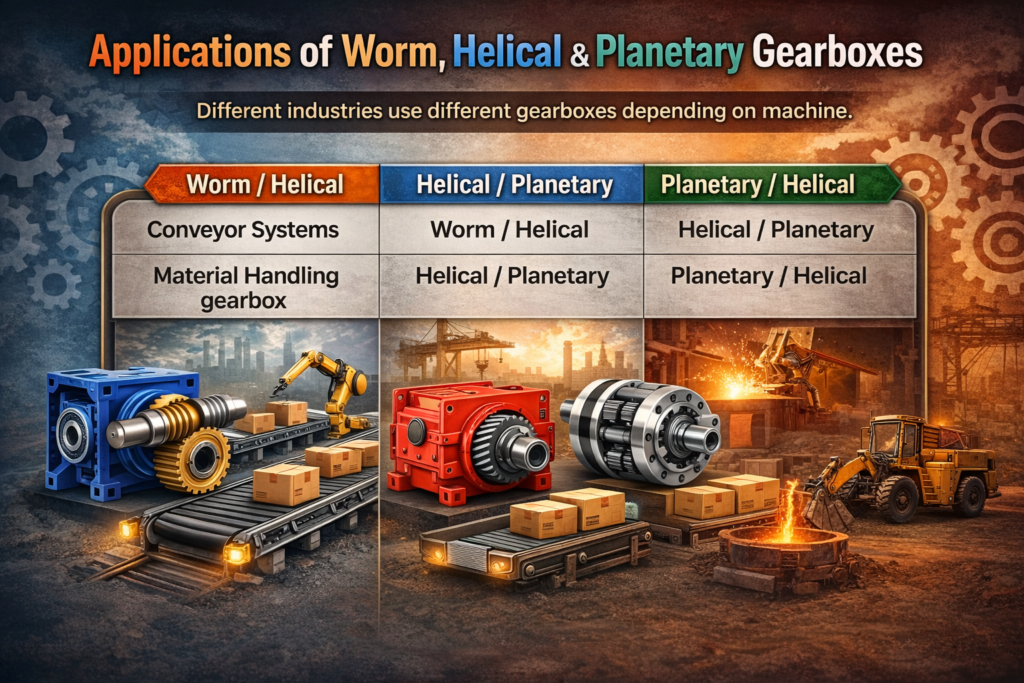
Different industries use different gearboxes depending on the machine.
| Application | Preferred Gearbox |
| Conveyor systems | Worm / Helical |
| Material handling gearbox | Helical / Planetary |
| Packaging machinery gearbox | Planetary / Helical |
| Heavy duty industrial gearbox | Helical / Planetary |
Worm gearboxes are common in conveyor system gearbox applications. Helical gearboxes are used in material handling gearbox and heavy machines. Planetary gearboxes are used in packaging machinery gearbox, robotics, and high precision equipment.
Common Mistakes to Avoid While Choosing a Gearbox
Many buyers select gearboxes only based on price, which causes problems later. Some common mistakes are-
- Ignoring correct gear ratio
- Not checking torque transmission
- Not considering backlash in gearbox
- Choosing wrong efficiency level
- Not checking load capacity
Always select gearbox based on machine requirement, not just cost.
Conclusion
Understanding the difference between worm vs helical vs planetary gearbox helps in choosing the correct system for your machine.
- Worm → compact, low cost, right angle
- Helical → strong, efficient, heavy duty
- Planetary → high torque, compact, precision
There is no single answer to which gearbox is best for industrial use. The best gearbox depends on load, speed, space, and application.
Need Help Choosing the Right Gearbox?
Selecting the right industrial gear motor or reduction gearbox can be confusing, especially when different applications require different designs.
At Nextork, we help industries choose the correct gearbox based on real machine requirements, load calculations, and performance needs. Whether you need a speed reducer for conveyors, heavy machinery, or automation systems, our team can guide you to the right solution.